How Does a Rotary Drum Screen Work?
The rotary drum screen, often referred to as a micro-screen, is a mechanical filtration system designed for efficient solid-liquid separation in wastewater treatment. Its operation relies on a continuous, rotating drum covered with a fine screen. Below is a brief overview of its supply scope and working principle.
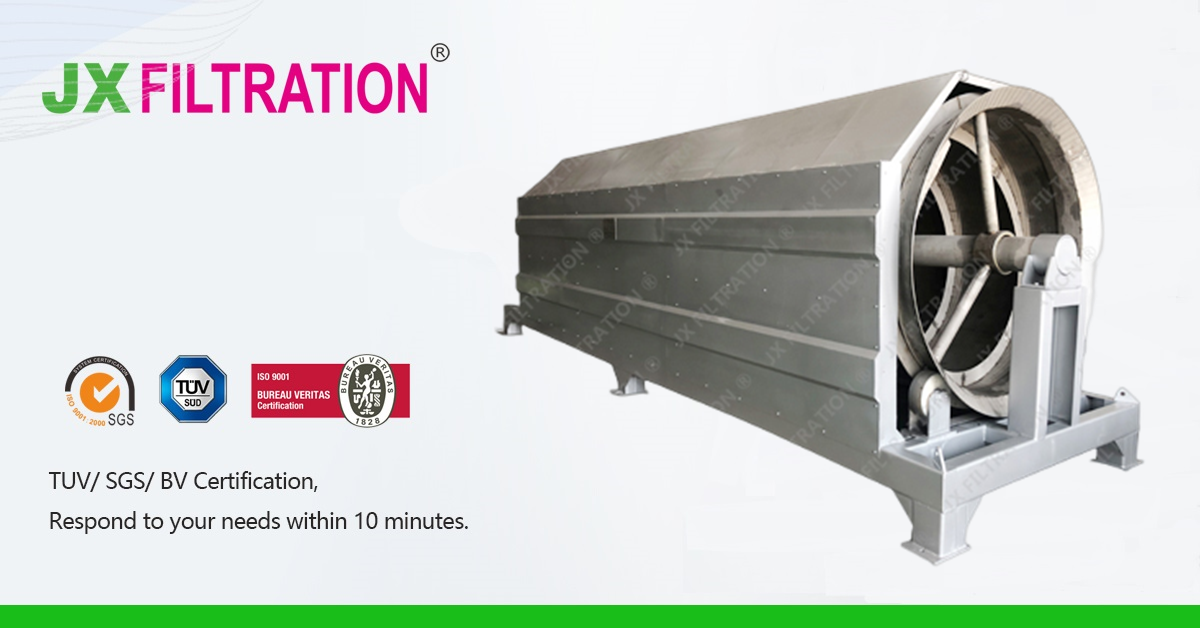
1. Supplying Scope
The rotary drum filter provided for a typical project is supplied as a complete set of equipment. The main components include:
-
Drive device
-
Main shaft
-
Rotary filter screen
-
Spray device (for cleaning the filter screen)
-
Water buffering and distribution baffle
-
Removable sealing plate
-
Water inlet and outlet
-
Vent valve
-
Scraper and other auxiliary parts
2. Working Principle
The process begins as the AC speed-regulating motor drives the screen cylinder via a reducer. Wastewater enters the tank through the inlet and rises to the filtered water line, guided by the water buffering and distribution baffle. Clean water passes through the screen gaps into the cylinder and is discharged from the bottom. Simultaneously, a spray device cleans the screen to prevent clogging.
Solids and fibrous organic matter larger than the screen openings are trapped on the drum’s surface. As the drum rotates, these impurities are carried to the opposite side and removed by a scraper or unloader. The filtered effluent flows into the outlet tank and is discharged continuously through the outlet.
This simple yet effective mechanical process allows the micro-screen to operate continuously with minimal maintenance, making it suitable for various pretreatment and filtration applications.
Any requirements, contact us now!
Grace
Email: grace@filtrationchina.com
Mobile/Whatsapp/WeChat: +86 17269571160